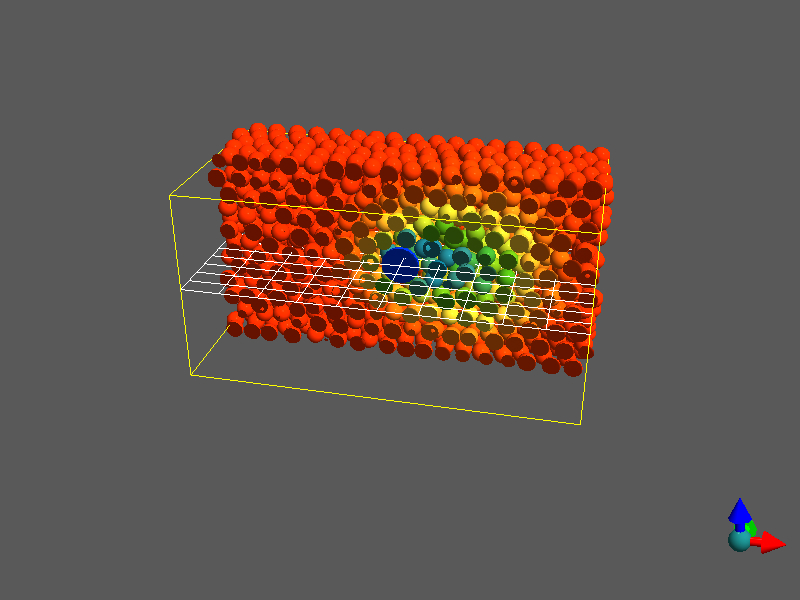
Boundary Reset
This example demonstrates how to use the “reset” boundary condition to simulate convection through a channel. In reset conditions, the initial concentration of a species is restored for a particle that crosses a reseting boundary.

Basic Setup
Initialize Mechanica for flow through a channel along the x-direction with reset conditions.
[1]:
import mechanica as mx

# Initialize a domain like a tunnel, with flow along the x-direction
mx.init(dim=[20, 10, 10],
        cells=[5, 5, 5],
        cutoff=5,
        bc={'x': ('periodic', 'reset'), 'y': 'free_slip', 'z': 'free_slip'})
Particle Types
Create two particle types,
one to represent parcels of fluid materials carrying a concentration of a species with entry concentration of
1.0, andone to act like a flow barrier and concentration sink, with constant species concentration of
0.0.
[2]:
class CarrierType(mx.ParticleType):
    """A particle type to carry stuff"""

    radius = 0.5
    mass = 0.1
    species = ['S1']
    style = {'colormap': {'species': 'S1', range: (0, 1)}}


class SinkType(mx.ParticleType):
    """A particle type to absorb stuff"""

    frozen = True
    radius = 1.0
    species = ['S1']
    style = {'colormap': {'species': 'S1', range: (0, 1)}}


carrier_type, sink_type = CarrierType.get(), SinkType.get()

carrier_type.species.S1.initial_concentration = 1.0
sink_type.species.S1.constant = True
Fluid Interactions
Construct fluid interactions for the following cases.
Fluid particles in the domain interact according to dissipative particle dynamics (DPD).
Sink particles act like a barrier for fluid flow.
[3]:
# Carrier type like a fluid
dpd = mx.Potential.dpd(alpha=1, gamma=1, sigma=0.1, cutoff=3 * CarrierType.radius)
mx.bind.types(dpd, carrier_type, carrier_type)

# Sink type like a barrier
rep = cp = mx.Potential.harmonic(k=1000,
                                 r0=carrier_type.radius + 1.05 * sink_type.radius,
                                 min=carrier_type.radius + sink_type.radius,
                                 max=carrier_type.radius + 1.05 * sink_type.radius,
                                 tol=0.001)
mx.bind.types(rep, carrier_type, sink_type)
[3]:
0
Convection
Apply a constant force to drive fluid flow towards +x, and diffusive transport between fluid particles and, at a faster rate, between fluid and sink particles.
[4]:
force = mx.ConstantForce([0.01, 0, 0])
mx.bind.force(force, carrier_type)

mx.Fluxes.flux(carrier_type, carrier_type, "S1", 0.001)
mx.Fluxes.flux(carrier_type, sink_type, "S1", 0.5)
[4]:
<mechanica.mechanica.MxFluxes; proxy of <Swig Object of type 'MxFluxes *' at 0x0000007DEAE99AB0> >
Particle Construction
Create a randomly distributed initial population of fluid particles, and place one sink particle at the center of the domain. Be sure that no fluid particles are initialized inside the sink particle.
[5]:
# Put a sink at the center and carrier types randomly, though not in the sink
st = sink_type(mx.Universe.center)
[carrier_type() for _ in range(2000)]
to_destroy = []
for p in carrier_type.items():
    if p.relativePosition(mx.Universe.center).length() < (sink_type.radius + carrier_type.radius) * 1.1:
        to_destroy.append(p)
[p.destroy() for p in to_destroy]
[5]:
[0, 0, 0, 0, 0, 0, 0, 0, 0, 0, 0, 0, 0, 0, 0, 0, 0, 0, 0]
[6]:
mx.ClipPlanes.create(mx.Universe.center, mx.MxVector3f(0, 1, 0))

mx.show()