Mechanica Documentation
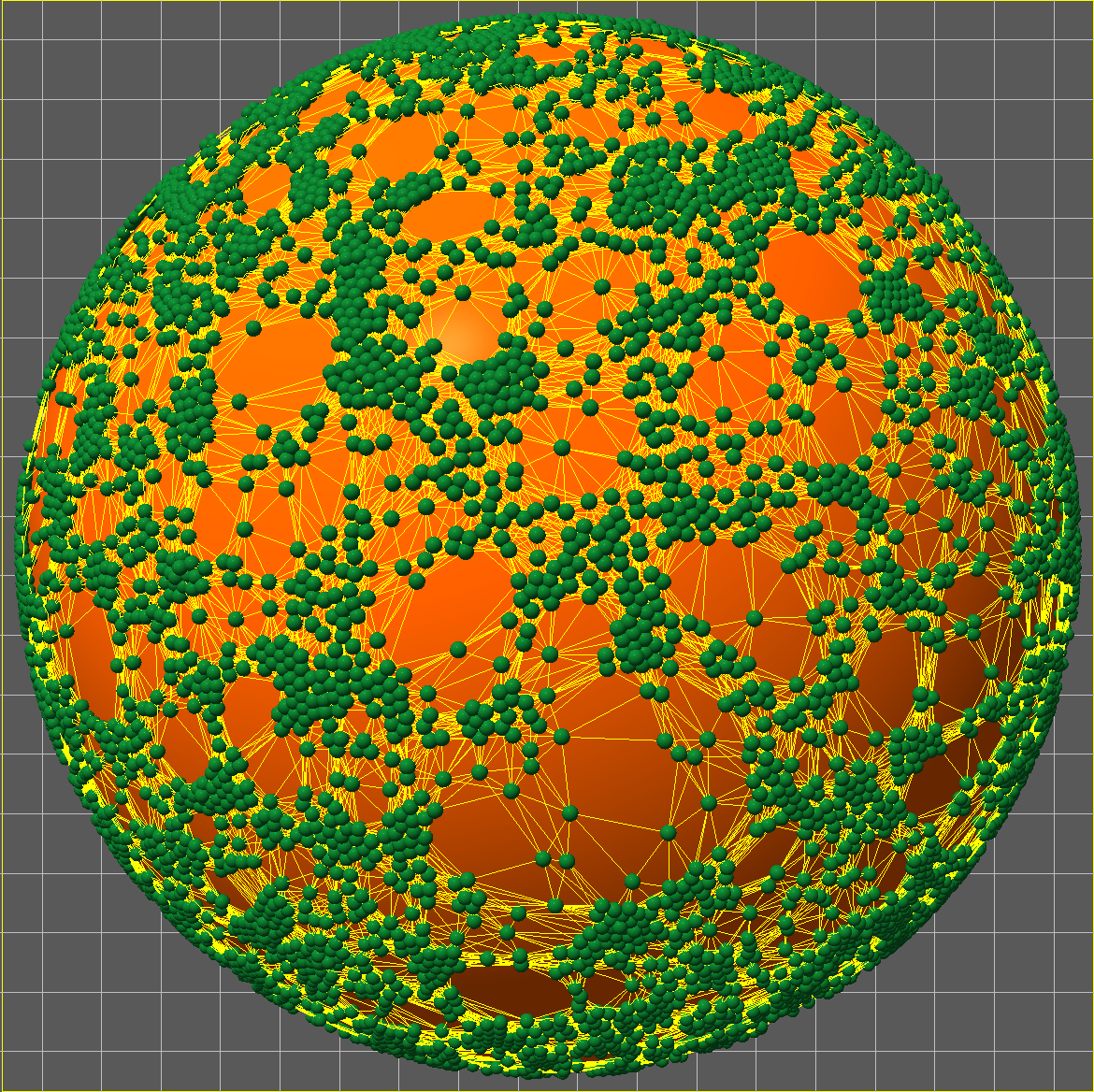
Mechanica is an interactive, particle-based physics, chemistry and biology modeling and simulation environment. Mechanica provides the ability to create, simulate and explore models, simulations and virtual experiments of soft condensed matter physics at mulitple scales using a simple, intuitive interface. Mechanica is designed with an emphasis on problems in complex subcellular, cellular and tissue biophysics. Mechanica enables interactive work with simulations on heterogeneous computing architectures, where models and simulations can be built and interacted with in real-time during execution of a simulation, and computations can be selectively offloaded onto available GPUs on-the-fly. Mechanica is part of the Tellurium project.
Mechanica is a native compiled C++ shared library that’s designed to be used for model and simulation specification in compiled C++ code. Mechanica includes an extensive Python API that’s designed to be used for model and simulation specification in executable Python scripts, an IPython console and a Jupyter Notebook. Mechanica currently supports installations on 64-bit Windows, Linux and MacOS systems.
Quick Summary
This documentation provides information on a number of topics related to Mechanica. If you’re looking for something specific, refer to the following,
To get Mechanica, refer to Getting Mechanica.
To get started with Mechanica, refer to Quickstart.
To learn about the physics and philosophy of Mechanica, refer to Introduction.
For walkthroughs, examples and other discussions, refer to Notes.
For application-specific models and tools, refer to Models.
To dive into the code, refer to Mechanica API Reference.
To run Mechanica online in JupyterLab,
 .
.
Note
Mechanica supports modeling and simulation in multiple programming languages. While many variables, classes and methods are named and behave the same across all supported languages, inevitably there are some differences. Most examples in this documentation demonstrate usage in Python, and specific cases where Mechanica behaves differently in a particular language are explicitly addressed. In general, assume that a documented example or code snippet in one language is the same in another unless stated otherwise. For specific details about Mechanica in a particular language, refer to Mechanica API Reference.
Funding
Mechanica is funded with generous support by NIBIB U24 EB028887.
Content